World of Warcraft: Forever After the Beta Launch: Realmless Play, Legacy Progression and a New Azeroth
World of Warcraft: Forever moved from announcement to playable testing on 17 September 2026, giving players their first direct look at Blizzard’s permanent reinterpretation of original Azeroth. The beta is scheduled to continue through 21 October, ahead of the global launch on 4 November 2026. Forever is not being presented as a temporary season or another preservation version of WoW Classic. It is intended to stand beside modern World of Warcraft and Classic as a separate, long-running game built around the original level 1–60 journey. Its biggest changes are not simply extra quests or revised class abilities. Blizzard is altering how players choose where to play, adding account-wide Legacy progression to make repeat levelling more meaningful, and expanding Eastern Kingdoms and Kalimdor with new regions, stories, dungeons and future updates. Because the beta has only just begun, some tuning may still change, but the overall structure and design direction are already clearly defined.
The Beta Begins with a Realmless Azeroth
The most unusual structural change in World of Warcraft: Forever is the decision to remove the traditional list of separate realms. Instead of picking a named realm before creating a character, players choose a ruleset that defines the type of experience they want. Blizzard has announced Normal, PvP and Roleplaying rulesets for the main game, with Hardcore due after launch. Each ruleset acts as a large connected ecosystem rather than a single conventional realm. This does not mean that every Forever player occupies one unrestricted shared space. Characters from different rulesets cannot simply group with each other, and the basic boundaries between play styles remain intact. The aim is narrower and more practical: reduce the chance that friends end up separated by an early realm choice and lessen the familiar launch-day problem in which one realm is overloaded while another struggles to maintain a healthy population.
Within the same ruleset, players will be able to form parties, enter dungeons and organise raids without first checking whether their characters were created on matching traditional realms. Horde and Alliance still remain separate for group play, preserving one of the central social divisions of original World of Warcraft. Blizzard is also introducing two-part character names that are unique across a region, which is designed to support recognisable identities in a much larger connected environment. Language preference is another part of the system, allowing players to indicate the language in which they want to interact. These decisions show that realmless play is not intended to erase community boundaries altogether. The design instead replaces thousands of small technical divisions with a smaller number of meaningful social choices based on rules, faction and language.
The distinction matters because WoW Classic has always relied heavily on repeated encounters with the same people. A player who helps with an elite quest today may appear again in a dungeon group next week, and guild reputations can spread because names become familiar. Blizzard says Forever is being built so that this recognition can still happen even when the overall population pool is much larger. That promise will be one of the most important things for the beta and early live game to demonstrate in practice. Large connected populations can make group formation easier and reduce the damage caused by declining realm populations, but they can also make individual players feel more anonymous if the world constantly reshuffles who appears around them. Forever therefore has to balance availability with familiarity rather than treating population size as the only measure of a healthy community.
What the Realmless Structure Means for Different Communities
The rulesets give Blizzard a way to preserve distinct styles of play without returning to the old realm list. Normal is the baseline cooperative option, with player-versus-player combat requiring mutual consent. PvP is designed for players who want hostile encounters in contested territory to remain a regular part of travelling through the world. Roleplaying is intended for communities that place greater value on character identity, social events and in-world interaction. Hardcore will operate as a more isolated environment because permanent death changes the value of every decision. These are more than labels at character creation: cross-ruleset grouping is not supported, so choosing a ruleset still has a lasting effect on who a character can routinely play with.
Hardcore also has special rules for account progress. Blizzard has said that collections and Legacy Points are generally shared across rulesets, but Hardcore is protected from progress earned elsewhere. Progress, collections and rewards earned by a Hardcore character can later become available outside Hardcore, while progress from Normal, PvP or Roleplaying does not flow back into the Hardcore environment. A dead Hardcore character will be able to transfer to another ruleset, including PvP, rather than being permanently unusable. This one-way approach is meant to keep Hardcore self-contained while still allowing players to retain value from the time they invested if a run ends. It also shows how the realmless model is being used to connect the wider game without making every part of it identical.
There is still an important unknown that a launch announcement cannot answer: whether players will actually feel that they belong to a community several months after release. Blizzard can control grouping rules, naming and population distribution, but long-term social behaviour depends on how often people meet again, how guilds form and whether local reputations still matter. The beta offers an early test of the technical and social framework, although a short test period cannot reproduce the pressures of a mature game with settled guilds, established economies and endgame routines. For that reason, the safest reading of the realmless system in September 2026 is that it solves several obvious realm-selection problems on paper while deliberately trying to preserve the human familiarity that made early World of Warcraft memorable. Its success will be measured less by queue times than by the quality of the communities that remain after launch.
Legacy Progression Makes Levelling Alts Part of the Long Game
Forever keeps level 60 as the destination, but Blizzard does not want a player’s first trip to maximum level to make every later character feel like a simple repetition. The Legacy system is designed around that problem. Players earn Legacy Points by completing Legacy Challenges tied to ordinary parts of the game, such as levelling a particular class or reaching a profession milestone. The idea is not to send players through unrelated checklists for artificial account points. Instead, common activities that already form part of the level 1–60 journey can contribute to wider account progress. This gives someone a reason to start another class, work on a different profession or approach familiar zones from another angle without replacing the normal experience, gear and character development that still belong to each individual hero.
Legacy Points are shared across a player’s alternate characters, but each character spends those points separately. At launch, the system begins with three trees: Professions, Adventure and Resourcefulness. The examples Blizzard has shown are practical rather than dramatic power jumps. Well Rested can improve rested experience and raise its cap, Bountiful Harvest can increase materials gained from gathering professions, and Reagent Economy can remove some reagent requirements from class abilities. A player might therefore build one alt around faster levelling while another uses the same account-wide pool to support gathering or day-to-day convenience. The crucial detail is that spending points on one character does not drain the shared total for every other character, so the system rewards account history without forcing all characters into the same build.
Blizzard is also placing limits around how quickly Legacy advantages can expand. At launch, each character can spend up to 16 points in its Legacy trees, while players can initially earn as many as 65 Legacy Points through challenges. Extra accomplishments still matter because accumulated points feed a Legacy Reward Track with cosmetic and prestige rewards, including the announced Spectral Bear Cub, rather than straightforward competitive power. The spending cap is intended to keep long-term players from turning their account history into an overwhelming advantage over newcomers during the early months. Blizzard has already said that the system can grow later through new challenges, new perks, higher spending limits, additional columns and potentially entirely new trees, making Legacy a framework for future progression rather than a fixed launch checklist.
How Legacy Changes Repeat Journeys Without Replacing Character Growth
The strongest idea behind Legacy is the separation between account knowledge and character identity. Traditional Classic-style levelling asks every new character to begin with very little, even when the person behind the keyboard already understands the routes, professions and class basics. Forever keeps the character-specific climb but allows previous journeys to leave a controlled mark on future ones. That can make an alt feel connected to an established account without turning it into a fully prepared level 60 character from the start. The difference is important because Blizzard has repeatedly described the journey itself as a core part of Forever. Legacy works only if it makes that journey richer or more flexible; if it simply removes the reasons to spend time in the world, it would undermine the design it is supposed to support.
The system also gives levelling a role beyond the first weeks after release. In many MMO launches, low-level areas are crowded at the beginning and become much quieter once the majority of active players reaches the endgame. Legacy Challenges give established players an additional reason to create new characters, try another class or pursue profession milestones later in the game’s life. That matters for Forever because Blizzard is putting unusual emphasis on an active outdoor world. A steady flow of alts can keep quest hubs, roads, profession routes and lower-level dungeons populated for longer. It also fits naturally with the realmless design: a larger connected pool and repeat levelling goals both increase the chance that a player looking for help at level 18 or 32 will still meet other people doing relevant content.
There is a sensible restraint to the launch version as well. Forever does not need every Legacy perk to be transformative on day one, because the more important purpose is to create continuity across years of play. Small advantages such as better rested experience, improved gathering returns or reduced everyday resource costs can feel worthwhile without invalidating the normal levelling route. The account-wide challenge structure also gives Blizzard room to add goals alongside future zones, professions and class combinations rather than raising the level cap every time the game receives a major update. In that sense, Legacy supports the “Forever” part of the name: progression can continue horizontally through new options and account goals while characters remain inside the original level 1–60 framework.
A New Azeroth Built Around the Original Level 1–60 Journey
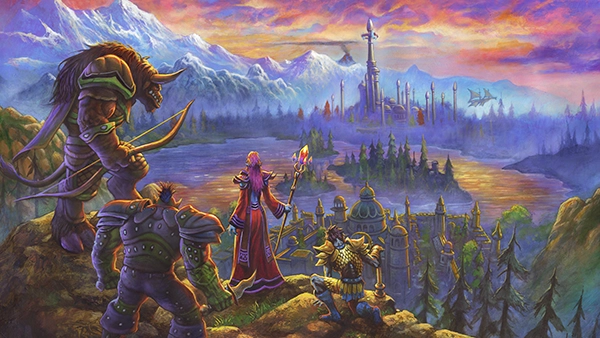
World of Warcraft: Forever is not recreating the 2004 map unchanged. Blizzard is using the Eastern Kingdoms and Kalimdor as the foundation for a version of Azeroth that can keep expanding without moving players into a chain of conventional expansions. More than 1,000 new quests are planned across the level 1–60 journey, including both completely new areas and additions to familiar zones. At the same time, several Classic principles remain in place: there are no flying mounts, there is no level scaling, preparation and travel still matter, and reaching level 60 does not make the rest of the world automatically adjust around the character. The result is meant to feel recognisably rooted in early World of Warcraft while removing the idea that the original continents must remain frozen exactly as they were two decades ago.
The four most prominent new or reworked regions announced for launch are Mount Hyjal, Shen’dralas, the Riverglades and Zephras Isle. Mount Hyjal deals with the aftermath of Archimonde’s defeat and opens a place that was central to Warcraft history but largely unavailable in the original game. Shen’dralas extends the story around Eldre’Thalas, Dire Maul and the centaur lands south of Desolace. The Riverglades is a frontier region with rivers, trade routes and struggling settlements, carrying more than 150 new quests across much of the mid-30s to mid-40s range. Zephras Isle provides a level 1–12 starting experience for the new Skyborne race, whose characters can join either faction and receive different class options depending on that allegiance. These additions are woven into levelling rather than reserved only for max-level players.
Existing regions are being changed as well, which may prove just as important as the headline locations. Blizzard has shown extra quest lines, profession hooks and small story additions in old starting areas, while places such as Wetlands and Desolace receive further content tied to characters and factions already present there. The visual presentation can also be adjusted to suit different preferences: Forever supports modern and Classic visual presets, HD and SD character models, restored Classic-style animations for HD models and optional transmogrification. Environmental work adds details such as flowing rivers in Elwynn Forest, mist over Darkshore and stronger lighting in Ashenvale without replacing the established art direction. The intention is a changed Azeroth that still reads immediately as the original world rather than a visually disconnected remake.
New Dungeons, Raids and the Road Beyond Launch
The expanded world is supported by new group content across the levelling range. Blizzard has announced nine new dungeons, including the Hall of Thanes beneath Ironforge, the Ruins of Lordaeron, the City of Dalaran, Blackmaw Hold, the Drowned City and several other locations drawn from long-standing corners of Warcraft lore. These dungeons are important because they give the new regions and story threads places to continue beyond outdoor quests. Forever is also reworking itemisation across existing content, adding hundreds of new drops and revisiting old dungeon rewards so that more classes and roles have meaningful reasons to run them. The goal is not to push every player towards a single newest activity, but to make a wider part of the world relevant during the trip to level 60.
At maximum level, Blizzard has announced Barrow Deeps as a 10-player raid and Hyjal Summit as a 20-player raid, with new raids scheduled to unlock on 9 December 2026 after the initial launch period. This mixed raid sizing sits beside the larger group traditions associated with original WoW and gives the developers room to create different types of organised encounters without abandoning the social scale of Classic-style raiding. PvP is also receiving new content through the Darkspear Islands, a 15-versus-15 battleground based around strategic control points and flag capture. These activities show how Forever plans to expand the original world horizontally: new destinations, rewards and encounters can arrive while the level cap remains 60 and older parts of Azeroth continue to have a purpose.
The announced roadmap makes that long-term model explicit. After the November launch and December raid opening, Blizzard plans further raids, dungeons, PvP updates, outdoor content, additional level 1–60 quests, Hardcore play and a future reworking of an iconic raid. That matters more than any single launch feature because Forever is being positioned as a permanent branch of World of Warcraft rather than a short experiment. The beta that began in September 2026 is therefore testing more than class balance or quest flow; it is the first public step for a version of Azeroth intended to grow without repeatedly replacing its own foundation. Realmless communities, Legacy progression and new regions all serve the same central idea: keep players moving through the original world, give repeated journeys lasting value and add new stories without making the roads that came before them irrelevant.