Addons and UI in 2026: a practical World of Warcraft setup that improves performance without clutter
By 2026, World of Warcraft’s default interface is genuinely strong: you can track important buffs, move frames, adjust key combat information, and play competitively without downloading anything. That said, many players still run into the same issues: missed interrupts, unclear enemy casts, messy raid frames, or too much time spent “looking for information” instead of reacting. The most reliable approach is not building a huge UI, but adding a small number of tools that solve specific gameplay problems.
Choosing the right addon set for your role (and avoiding “addon overload”)
The biggest mistake players make is installing a long list of popular addons without understanding what each one actually replaces. When multiple addons try to do the same job (for example, several sources of warnings or multiple combat trackers), you get duplicated alerts, inconsistent information, and a UI that feels noisy. In 2026, the smarter move is to decide what you need based on your role: tank, healer, DPS, or PvP-focused player.
For most PvE players, the “core” kit is surprisingly small: improved nameplates to read dangerous casts and priority targets, a boss-mod addon for raid and Mythic+ mechanics, and a cooldown/buff tracking solution. Tanks typically benefit the most from readable nameplates and defensive tracking; healers gain the most from raid frame clarity and debuff visibility; DPS players gain consistent cooldown tracking and clean proc notifications. If you focus on these essentials, your UI stays quick and easy to maintain.
To keep things clean, use a simple rule: one addon per function. One system for nameplates, one for mechanics alerts, one for cooldown tracking, and one for damage/healing analysis. Everything else should be optional. If an addon doesn’t clearly improve decision-making or reduce mistakes, it’s not a “must-have” — it’s just extra maintenance and potential performance cost.
Recommended “minimal kit” for 2026 and what each tool is for
Nameplates: A modern nameplate addon such as Plater remains one of the highest-value upgrades because it improves how you read the battlefield. It can highlight priority enemies, emphasise dangerous casts, show interrupt status, and make Mythic+ pulls easier to manage. In 2026, it’s still widely used because nameplates are where fast decisions happen, especially in dungeons and PvP.
Mechanics alerts: For raids and Mythic+, a boss-mod addon like Deadly Boss Mods (DBM) or BigWigs continues to be standard. The value here is not “telling you what to do”, but helping you time personal cooldowns, movement, and pre-positioning. Many groups expect you to have one of these because it reduces avoidable wipes and makes coordination more consistent.
Tracking and analysis: For cooldowns and key buffs, players usually choose between WeakAuras (more flexible) or lighter tracking addons that provide simpler displays. For performance review, Details! remains the common choice because it helps you understand what happened in a wipe, why damage dropped, or whether cooldown usage was correct. The best practice is to use tracking for decisions in combat, and analysis for learning after combat — not to cover the entire screen while fighting.
Optimising the interface for Mythic+ and raids in 2026
High-end PvE content punishes slow information. In Mythic+, most deaths come from the same sources: avoidable casts, missed interrupts, badly timed defensives, and unclear target priority. In raids, problems usually come from mechanics assignments, not knowing when your personal responsibility happens, or failing to see debuffs clearly. A good 2026 UI solves these problems by improving readability and reducing time-to-reaction.
For Mythic+, nameplates should help you answer three questions quickly: which enemy is most dangerous, which cast must be interrupted, and which target should die first. Many players tune their nameplates to emphasise key casts with larger fonts or colour changes, show interrupt immunity, and track important debuffs. This becomes more important in big pulls where the default UI can feel visually busy.
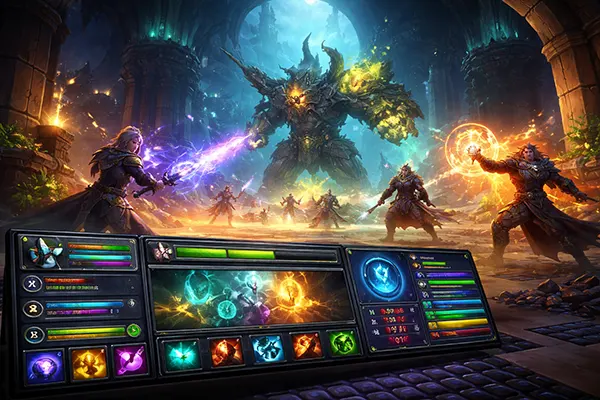
For raids, the priority is predictable information placement. Your raid frames must clearly show dispellable debuffs, incoming damage situations, and key cooldown timers. Your character’s resources and personal defensive cooldowns should be visible without forcing you to look away from mechanics. In 2026, the goal is to keep the centre of the screen clean so you can see the fight, while placing decision tools (cooldowns, defensives, debuffs) in consistent, easy-to-scan areas.
UI placement and settings that reduce mistakes (without turning the screen into a dashboard)
Keep the “mechanics zone” clear: the centre of the screen is where you must see ground effects, boss animations, and enemy movement. If you stack bars, trackers, meters, and chat windows in the centre, you will lose fights to visibility problems rather than skill. Put essential info near your character, but slightly below or to the side, so you can read it without blocking mechanics.
Make your interrupt and defensive awareness effortless. If you are the type of player who misses interrupts, do not rely on tiny default cast bars. A good nameplate setup makes casts obvious, shows whether your interrupt is ready, and helps you spot when another player has already kicked. If you are a tank or healer, ensure your defensives or major throughput cooldowns are displayed in a way that prevents overlap and confusion.
Test your UI in realistic conditions. A UI that looks good in a city often fails in real combat: too many nameplates, too many timers, and too much motion. Run a few Mythic+ keys or raid pulls and note what you didn’t notice in time. Then adjust. A great UI is not created in one evening — it is refined by removing what you don’t need, not adding more.
Performance, safety, and maintenance: keeping addons stable through 2026 updates
Addons are a tool, but they’re also a risk if you ignore maintenance. Patch cycles, expansion updates, and API changes can break addons or cause errors that impact performance. In 2026, many players aim for a “stable” addon set that rarely changes, because the worst UI is the one that collapses the week you start progression or push rating.
Performance issues usually come from heavy combat logging, overly complex WeakAuras, large nameplate scripts, or outdated addons that generate errors. If your FPS drops in large pulls, it’s often not the game itself — it’s the amount of work the UI is doing. The solution is to keep only what you use, update regularly, and disable things you don’t need for a session (for example, heavy meters during casual play).
Security matters as well. Addons should be downloaded from reputable sources, kept updated, and reviewed if they request unusual permissions or behave strangely. While the game sandbox limits what addons can do, unsafe downloads can still cause problems for your system outside the game. Treat your addon folder like a toolbox: trusted items, kept clean, and checked after updates.
A quick one-evening checklist for a clean, stable UI in 2026
Step 1: Pick your “one-per-function” setup. Choose your nameplates (for example, Plater), your boss-mod (DBM or BigWigs), your tracking (WeakAuras or a simpler tracker), and one analysis tool (Details!). Avoid stacking alternatives that do the same job — that’s where clutter starts.
Step 2: Remove everything you don’t actively use. If an addon has not helped you make a decision, avoid a death, improve healing clarity, or speed up gameplay, it’s probably just noise. Disable it for a week and see if you miss it. Most players discover they perform better when the UI is simpler.
Step 3: Update and stress-test after each major patch. Run a dungeon with large pulls, do a raid pull, and watch for errors, FPS drops, or unreadable visuals. Adjust fonts, sizes, and placement until you can react without searching your screen. A stable UI is not the flashiest one — it’s the one you can trust when the fight gets messy.