Dredge Mobile Review — Is a Slow Exploration Pace Suitable for Short Mobile Sessions?
Dredge arrived on mobile after gaining attention on PC and consoles for its unusual mix of fishing, exploration, and subtle horror elements. On smaller screens, however, expectations shift: players often engage in shorter bursts, during commutes or breaks. This raises a practical question — does a deliberately slow, methodical game like Dredge adapt well to quick mobile sessions, or does its pacing work against the habits of mobile users? :contentReference[oaicite:0]{index=0}
Core Gameplay Loop and Mobile Adaptation
At its core, Dredge revolves around sailing between islands, catching fish, managing inventory, and gradually uncovering narrative fragments. The loop is intentionally restrained. There is no pressure to rush, and most actions are tied to the in-game day-night cycle. On mobile, this structure translates surprisingly well because each loop can be naturally segmented into short sessions lasting 5–10 minutes.
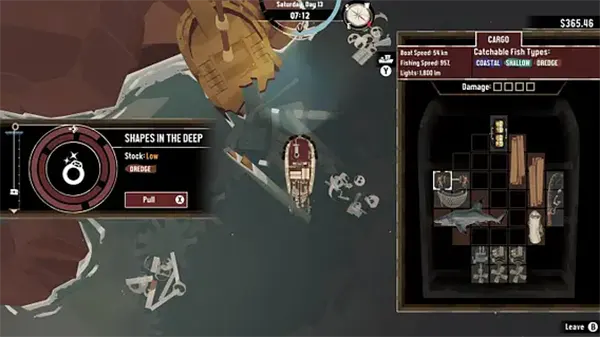
Touch controls have been adapted with reasonable care. Steering, casting lines, and navigating menus feel responsive, though not as precise as on a controller. Importantly, the interface has been simplified without removing depth. Inventory management — a key part of gameplay — remains intact, encouraging strategic thinking even during short play periods.
However, the absence of quick, high-intensity rewards may feel unusual for mobile audiences accustomed to instant feedback. Dredge deliberately avoids frequent dopamine spikes. Instead, it builds engagement through gradual progression and atmosphere, which may appeal more to players seeking a calmer, more deliberate experience.
Session Length vs Game Design Intent
Dredge was not originally designed for fragmented play. Its pacing assumes continuity — players are expected to remember routes, objectives, and subtle narrative cues. On mobile, this can create friction, especially if sessions are interrupted frequently or spread across several days.
That said, the game’s structure allows for natural stopping points. Docking at a harbour, completing a fishing run, or upgrading equipment all provide clear moments to pause. These micro-goals make it easier to engage in short sessions without losing track of progress.
The main limitation appears when pursuing longer objectives, such as multi-step quests or exploration of distant areas. These require sustained attention and time investment, which may not align with typical mobile usage patterns.
Atmosphere, Audio, and Immersion on Mobile
Dredge’s identity relies heavily on its atmosphere. Fog, dim lighting, and subtle distortions create tension without relying on overt action. On mobile devices, the visual style remains intact, though smaller screens can reduce the impact of environmental details.
Audio design plays a crucial role. The ambient soundtrack and environmental sounds reinforce a sense of unease, particularly during night-time exploration. With headphones, the experience translates effectively even on mobile, preserving much of the original tone.
However, immersion depends heavily on context. Playing in a noisy environment — such as public transport — can diminish the intended effect. Unlike fast-paced games, Dredge benefits from focused attention, which is not always feasible in mobile scenarios.
Does Slower Pacing Enhance or Limit Engagement?
The slower tempo can be both a strength and a limitation. For players seeking a break from fast, repetitive mobile titles, Dredge offers a distinct alternative. It encourages observation, planning, and patience rather than reflex-based interaction.
On the other hand, the lack of urgency may reduce engagement during brief sessions. Without immediate goals or rewards, some players may feel less motivated to return frequently. This contrasts with typical mobile design, where retention is often driven by rapid progression systems.
Ultimately, the pacing aligns better with players who treat mobile gaming as a relaxed, intentional activity rather than a quick distraction.
Performance, Controls, and Practical Considerations
From a technical perspective, Dredge performs reliably on most modern smartphones. Load times are acceptable, and frame rates remain stable during exploration and fishing sequences. Battery consumption is moderate, though extended sessions will naturally drain power more quickly due to the game’s visual complexity.
Controls, while functional, require a short adjustment period. Touch input lacks the tactile feedback of physical controls, particularly when navigating tight spaces or managing inventory grids. Nevertheless, after some time, interactions become intuitive.
Offline play is another practical advantage. Dredge does not rely on constant connectivity, making it suitable for travel or areas with limited network access — a key factor for mobile usability.
Who Will Benefit Most from the Mobile Version?
The mobile version is best suited for players who appreciate slower, narrative-driven experiences and are willing to engage with the game over multiple sessions. It works particularly well for those who prefer thoughtful gameplay over fast-paced action.
Conversely, players expecting quick rewards or competitive mechanics may find the experience less compelling. The game does not adapt its core design to typical mobile expectations — it remains consistent with its original vision.
In practical terms, Dredge on mobile functions as a portable extension of the original game rather than a redesigned experience. Its success depends largely on whether the player’s habits align with its deliberate pacing.