Cloud Gaming in 2026: Technical Limits, Real Performance and Structural Risks
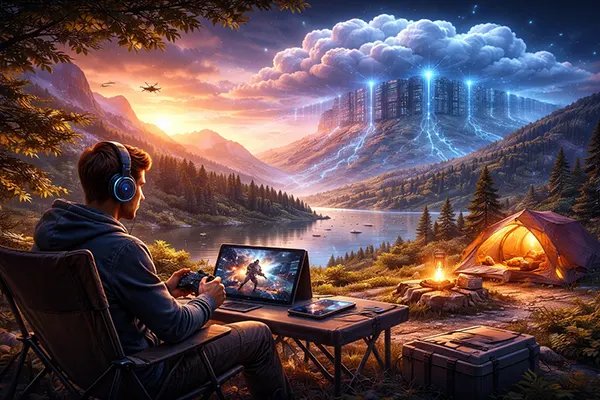
Cloud gaming has moved beyond early experimentation and is now a stable part of the games industry. By 2026, services such as NVIDIA GeForce Now, Xbox Cloud Gaming and Amazon Luna operate across Europe with 4K streaming tiers, browser access and integration into smart TVs. Yet the practical experience still depends heavily on network conditions, licensing models and the type of player. This article examines how latency affects gameplay, what “ownership” means in a streamed ecosystem, who benefits most from cloud access, and whether remote servers can realistically replace a local gaming PC.
Latency and Technical Constraints: The Core Performance Question
Latency remains the defining technical limitation of cloud gaming in 2026. Even with fibre broadband offering 1 Gbps download speeds in many UK cities, total input latency includes controller response time, encoding delay, server processing and video decoding. In optimal conditions, premium tiers report end-to-end latency between 25 and 45 milliseconds. For single-player titles this is acceptable. For competitive shooters or fighting games, it can still feel noticeably slower than a locally rendered 120 Hz system.
Network stability matters more than raw speed. A household connection advertised at 500 Mbps can still experience packet loss, jitter or congestion during peak evening hours. Cloud systems attempt to compensate through adaptive bitrate streaming, but image compression artefacts remain visible during fast camera movement. This is particularly evident in darker scenes or high-detail environments where compression struggles to maintain clarity.
Infrastructure geography also plays a role. The closer a user is to a data centre, the lower the physical transmission delay. In 2026, Western Europe benefits from dense server coverage, but rural regions still report higher latency. While 5G networks reduce delay compared to older mobile standards, real-world performance fluctuates significantly depending on signal quality and network load.
How Latency Influences Real Gameplay Scenarios
In slower-paced genres such as strategy, role-playing or narrative adventure games, latency rarely breaks immersion. A delay of 30–40 milliseconds is difficult to perceive when issuing tactical commands or exploring open environments. For these categories, cloud gaming can feel close to native hardware performance.
Competitive esports titles tell a different story. Professional-level play often demands sub-10 millisecond responsiveness, particularly in first-person shooters or reaction-based fighting games. Even minor delay can affect recoil control, timing windows or precision aiming. As a result, serious competitors still prefer local hardware, where rendering and input processing happen instantly on the same machine.
Sports simulations and racing games sit somewhere in between. Casual players may not notice minor latency, but experienced users often report subtle differences in steering sensitivity or ball control. Cloud systems have improved predictive input algorithms by 2026, yet they cannot entirely eliminate the physical reality of distance between user and server.
Digital Ownership and Licensing: Who Really Controls the Game?
Cloud gaming reshapes the concept of ownership. In traditional PC gaming, purchasing a title usually grants a licence tied to a personal account, with the ability to download and store the game locally. In cloud ecosystems, access depends not only on the licence but also on the continued operation of the service provider. If a title leaves the streaming catalogue or a service discontinues support, practical access may disappear.
Subscription-based models complicate this further. Xbox Game Pass Ultimate, for example, combines streaming access with a rotating library. Players do not own the games; they rent access under contractual terms. When licensing agreements expire, titles can be removed. This dynamic mirrors the film streaming industry more than traditional game ownership.
There are also concerns about digital preservation. If a cloud-only title is never distributed for local installation, its long-term survival depends entirely on the company maintaining server infrastructure. In 2026, industry discussions increasingly address archival responsibility and consumer rights in digital environments.
Consumer Risks and Practical Safeguards
The primary risk for players is service dependency. If a provider raises subscription fees, changes regional availability or shuts down operations, access can be interrupted. The closure of several early cloud services earlier in the decade demonstrated that market consolidation is real, and not every provider survives long term.
Another factor is account security. Because all gameplay and purchases are tied to a central account, losing access through hacking or policy violations can mean losing an entire library at once. Strong authentication practices, including hardware-based two-factor verification, are now standard recommendations.
From a legal standpoint, users should review licence terms carefully. In most jurisdictions, including the UK and EU member states, digital purchases are governed by consumer protection laws, but these laws focus on service quality rather than perpetual access guarantees. Cloud gaming access remains fundamentally conditional.
Casual Players, Cost Efficiency and the Future of Local PCs
For casual players, cloud gaming in 2026 offers clear advantages. There is no need to invest £1,200 or more in a high-end graphics card, particularly during hardware supply fluctuations. A mid-range laptop, tablet or even a smart television can run demanding titles through streaming. This lowers the barrier to entry and makes high-fidelity gaming more accessible.
Maintenance is also simplified. Updates, patches and driver management occur on remote servers. Users avoid lengthy downloads and storage limitations. For households with limited disk space or shared devices, this convenience is significant. It also reduces energy consumption on the user’s side, as heavy processing occurs in large-scale data centres designed for efficiency.
However, long-term subscription costs should be considered. Paying £15–£20 per month over several years can equal or exceed the price of a mid-range gaming PC. The economic benefit depends on how frequently a person plays and whether they value hardware ownership and offline capability.
Can Cloud Gaming Fully Replace the Local PC?
As of 2026, full replacement remains unlikely for all segments of the market. Enthusiasts who demand ultra-high refresh rates, mod support and complete control over graphical settings still rely on local systems. Modding communities in particular require file access that cloud environments typically restrict.
Creative professionals who combine gaming with content creation also benefit from powerful local hardware. Streaming, video editing and game development workflows demand consistent, low-latency performance that cloud gaming alone does not provide.
Nevertheless, for a large proportion of casual and semi-regular players, cloud access is sufficient. The model reduces upfront costs and hardware complexity while delivering stable 1080p or 1440p performance under good network conditions. Rather than eliminating local PCs, cloud gaming in 2026 functions as a parallel ecosystem—expanding access, but not fully replacing traditional hardware.