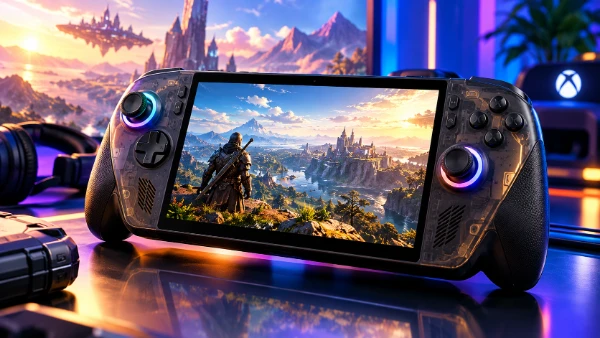
ASUS ROG Xbox Ally X20: What Gamers Get from the New OLED Handheld
ASUS has marked the 20th anniversary of Republic of Gamers with the ROG Xbox Ally X20, a premium handheld gaming PC that introduces several meaningful improvements to the existing Ally range. Released on 15 October 2026, the device features a 7.4-inch OLED display, redesigned controls, improved cooling and distinctive anniversary styling. It retains the powerful AMD Ryzen AI Z2 Extreme processor while refining the features players interact with most often. With a starting price of $1,299, the X20 is aimed at enthusiasts who want a high-quality portable gaming experience without giving up access to their Windows game libraries. But how much has actually changed, and are the upgrades significant enough to justify the additional cost?
A New OLED Screen and a Redesigned Anniversary Edition
The biggest change in the ASUS ROG Xbox Ally X20 is its 7.4-inch ROG Nebula HDR OLED display. Previous ROG Xbox Ally models used 7-inch IPS screens, making the X20 the first handheld in this particular range to adopt OLED technology. The new panel maintains a Full HD resolution of 1920 × 1080 pixels and a 120Hz refresh rate, but offers deeper blacks, improved contrast and more vivid colours. Unlike traditional LCD screens, which rely on a backlight, OLED pixels produce their own light. This allows dark areas to appear genuinely black instead of slightly grey, an improvement that is particularly noticeable in atmospheric games, nighttime environments and scenes with strong lighting contrasts.
Screen brightness has also received attention. ASUS specifies 600 nits for standard content and up to 1,400 nits for HDR highlights. The display supports Dolby Vision, VESA DisplayHDR 1000 and AMD FreeSync Premium Pro, combining high-quality colour reproduction with smoother motion. Its 0.2ms response time helps reduce visible ghosting during rapid movement, while variable refresh rate technology adjusts the screen to the game’s actual frame output. Players should not expect every demanding title to run at 120 frames per second, but games operating below that figure can still benefit from more consistent presentation. Corning DXC glass and an anti-reflective coating, which ASUS claims reduces glare by 65%, make the display more practical in brightly lit rooms.
Beyond the screen, ASUS has given the X20 an appearance that distinguishes it from the regular Xbox Ally models. Its translucent black casing reveals elements of the internal construction, including a gold-coloured structure created to celebrate the ROG brand’s 20th anniversary. The design references the transparent electronics that were popular during earlier generations of gaming hardware. The device weighs approximately 756g, making it heavier than the standard ROG Xbox Ally X, which weighs around 715g. That difference may become noticeable during longer sessions, although the revised shape and rubberised grips are intended to improve comfort and make the console feel more secure in the hands.
Better Controls, Precision Joysticks and More Comfortable Gaming
The ROG Xbox Ally X20 introduces TMR joysticks, replacing conventional stick technology with sensors designed to provide more accurate movement detection and improved resistance to wear. TMR stands for tunnelling magnetoresistance, but the practical advantage is straightforward: the sticks detect movement magnetically rather than relying on the same type of physical electrical contact used in traditional potentiometer designs. ASUS specifies a tight 3% dead zone and a control system intended to avoid unwanted directional snapping. This can be particularly useful in shooting games, racing titles and other genres where small adjustments matter. The technology should also reduce the risk of stick drift developing over time, although it cannot guarantee that a controller will never experience mechanical problems.
Another notable addition is the transforming directional pad. Players can switch between four-way and eight-way movement without using tools, allowing the controls to suit different genres. Four-way input works well for games requiring clearly separated directional commands, while eight-way movement is better suited to fighting games and certain arcade titles. ASUS has also redesigned the face buttons so they sit flush with the casing when fully pressed. Their lighter actuation is intended to make repeated inputs more comfortable, especially when moving a thumb rapidly between buttons. The handheld retains Xbox-style analogue triggers with vibration feedback, two assignable rear buttons and motion controls, giving players several ways to customise their preferred setup.
Comfort is especially important because the X20 is substantially larger than a traditional pocket-sized gaming device. Its Xbox-inspired grips help distribute weight across the palms rather than concentrating pressure on the fingertips. The rubberised surfaces also provide additional stability during fast-paced sessions. Players can adjust the functions of the Command Centre, Library and Action buttons through Armoury Crate Special Edition, reducing the need to navigate menus for frequently used commands. These changes may appear less dramatic than the OLED upgrade, but they address everyday frustrations that become more noticeable after several hours of gaming. For players who regularly use a handheld instead of a controller connected to a television, improved input precision and grip comfort can be particularly valuable.
Gaming Performance, Battery Life and Everyday Features
Inside the ROG Xbox Ally X20 is AMD’s Ryzen AI Z2 Extreme processor, the same processor family used in the 2025 ROG Xbox Ally X. It combines an eight-core CPU with integrated Radeon graphics designed for demanding portable gaming. The handheld also includes 24GB of LPDDR5X memory and a 1TB PCIe 4.0 SSD. These specifications provide enough memory for modern games alongside the operating system and background applications, while the storage capacity accommodates a reasonable collection of larger titles. Some recent PC releases can occupy more than 100GB each, however, so players with extensive libraries may still need additional storage. The presence of a full Windows 11 Home installation means the X20 can run compatible PC games and applications rather than being restricted to a dedicated console operating system.
In practical terms, the X20 is designed to handle popular contemporary PC games, although the best settings will depend on the title and available power. Less demanding releases, such as Hades II, Hollow Knight: Silksong and many older games, are particularly well suited to handheld play. Visually intensive titles such as Cyberpunk 2077 or Black Myth: Wukong may require reduced graphics settings, upscaling or a lower rendering resolution to maintain comfortable performance. The 1080p screen provides a sharp image at its relatively small size, but attempting to run every demanding game at native resolution and maximum detail is not realistic. Because the X20 uses the same processor as the previous premium model, its main selling points are not a major generational increase in raw gaming power.
ASUS has also redesigned the cooling system to manage heat more effectively. Airflow is directed towards the processor, heatsink and the area behind the OLED screen, where temperature control is particularly important. According to the manufacturer, the revised fans improve airflow by 20%, while a larger heatsink surface helps dissipate heat. The changes are intended to keep the grips comfortable during extended play and maintain consistent operation under demanding workloads. The X20 retains an 80Wh battery, but actual running time varies considerably between games. A demanding title running at higher power can exhaust the battery in roughly two hours, whereas lighter games with reduced brightness and more conservative performance settings may last substantially longer. The OLED screen alone does not guarantee better battery life, particularly when displaying bright scenes.
Windows 11, Xbox Features and Improvements to Armoury Crate
The ROG Xbox Ally X20 operates on Windows 11 Home with a gaming-focused Xbox experience designed for controller navigation. Players can access supported games from the Xbox PC app, Steam, Battle.net, Epic Games Store and other Windows-compatible launchers. This flexibility is one of the device’s strongest advantages over handheld consoles with tightly controlled game catalogues. Existing PC purchases can often be installed without buying another copy, provided the game and its launcher support the hardware. Xbox Play Anywhere titles can also share purchases and progress between supported Xbox consoles and Windows PCs, while Xbox Cloud Gaming and Remote Play offer additional ways to access games when a suitable internet connection is available. A Game Pass subscription is required for the relevant subscription benefits.
Armoury Crate Special Edition has received several improvements alongside the X20. Its revised interface offers more readable menus and easier access to game-specific settings. Default Game Profile 2.0 lets players save adjustments, such as power limits and performance preferences, to individual titles instead of repeatedly configuring them before every session. ASUS has also introduced HDR Native and HDR Vivid display modes. The former aims to preserve the intended appearance of supported HDR content, while the latter increases colour intensity for players who prefer a more pronounced image. The RGB lighting around the joysticks now includes Reactive Mode, which responds to stick direction, and Immersion Mode, which reacts to directional in-game audio. These features are optional rather than essential to performance.
Several smaller conveniences make the X20 easier to use outside the home. The new Travel Mode limits charging power to 65W, improving compatibility with certain aircraft and train power sockets. It can activate automatically when Airplane Mode is enabled or be selected manually. Connectivity includes Wi-Fi 6E, Bluetooth 5.4, two USB-C connections with different capabilities, a 3.5mm audio jack and a microSD Express card reader. One USB-C port supports USB4 and compatible external displays, making it possible to connect the device to a larger screen through appropriate accessories. The handheld also includes stereo speakers with Dolby Atmos support and a fingerprint reader for convenient Windows sign-in. As with other Windows gaming handhelds, occasional launcher updates, desktop menus and compatibility adjustments remain part of the experience.

ROG Xbox Ally X20 Price, Accessories and Value in 2026
ASUS officially released the ROG Xbox Ally X20 on 15 October 2026, with a recommended US price of $1,299 for the standalone device. This positions it $300 above the ROG Xbox Ally X, which launched at $999, and considerably above the standard ROG Xbox Ally at $599. European pricing varies by market, with the X20 listed at €1,399.99 on the French ASUS website in October 2026. The higher price reflects the OLED display, upgraded controls, revised cooling system and anniversary construction rather than a substantially faster processor. That distinction matters when comparing value: buyers are primarily paying for a more refined gaming experience, not a completely new level of game performance. Local taxes, retailer discounts and regional stock availability can affect the final purchase price.
ASUS also offers an anniversary bundle priced at $2,499 in the United States. It includes the ROG Xbox Ally X20, ROG XREAL R1 Edition 20 gaming AR glasses, a customised dbrand Killswitch protective case and a Pelican carrying case designed to accommodate the equipment. The AR glasses connect through USB-C and create the appearance of a much larger virtual screen, with ASUS advertising an image equivalent to 171 inches viewed from four metres away. They use micro-OLED displays with a 240Hz refresh rate and support head tracking, allowing the virtual image to respond to movement or remain anchored in position. This makes the bundle an unusual option for players interested in a private large-screen experience during travel, although the glasses are an accessory rather than a requirement for using the handheld.
Choosing between the standalone X20 and its expensive bundle depends largely on how the device will be used. Players who mainly want a high-quality handheld screen are unlikely to gain enough practical value from the AR accessories to justify the additional $1,200. A protective case, compact charger or suitable travel bag may be more useful purchases for regular commuting. The standalone device already offers a complete gaming experience, and its built-in OLED display is one of its main attractions. The bundle makes more sense for collectors, frequent travellers who specifically want a virtual large screen, or enthusiasts already considering dedicated AR gaming glasses. Buyers should also remember that attaching external accessories can increase power consumption and reduce the convenience of a self-contained handheld setup.
Should You Upgrade from the ROG Xbox Ally X or Choose Another Handheld?
For owners of the 2025 ROG Xbox Ally X, the decision is relatively straightforward. Both premium models use the Ryzen AI Z2 Extreme processor, offer 24GB of memory and include a 1TB SSD and an 80Wh battery. The X20 therefore does not provide the sort of performance improvement normally associated with replacing an older console generation. Its advantages are concentrated in the larger OLED screen, reduced reflections, refined physical controls and updated cooling design. Players satisfied with their existing Ally X, particularly those who mostly play games on an external monitor, have limited reasons to upgrade. Those who spend most of their gaming time looking directly at the handheld display may find the OLED panel and revised controls much more appealing.
The X20 also faces competition from alternatives such as the Steam Deck OLED, Lenovo Legion Go handhelds and other Windows-based gaming PCs. Valve’s Steam Deck OLED remains attractive for players who value straightforward handheld controls, a well-integrated gaming interface and access to a large Steam library, although its Linux-based operating system can create compatibility limitations for certain games and anti-cheat systems. Windows competitors offer broader launcher compatibility, but screen quality, battery capacity, weight and price vary between individual models. The X20’s combination of a 1080p OLED display, variable refresh rate, Xbox-oriented controls and Windows support is distinctive. Nevertheless, buyers should compare the games they actually play, since a more expensive handheld does not automatically provide a better experience with every title.
The ASUS ROG Xbox Ally X20 is best suited to enthusiasts buying a premium handheld for the first time, players who particularly value OLED image quality and users who want access to multiple PC game stores without maintaining a separate gaming laptop. Its strongest improvements are visible and tangible: a brighter screen, better contrast, more precise controls and additional comfort-focused features. The drawbacks are equally important. At 756g, it is not especially light, demanding games still place considerable pressure on battery life, and the $1,299 price is difficult to justify purely on performance grounds. As of October 2026, the X20 represents a carefully refined version of ASUS’s existing handheld concept rather than a radical reinvention. For buyers who will genuinely use its display and control improvements, that refinement may be enough to make it worthwhile.